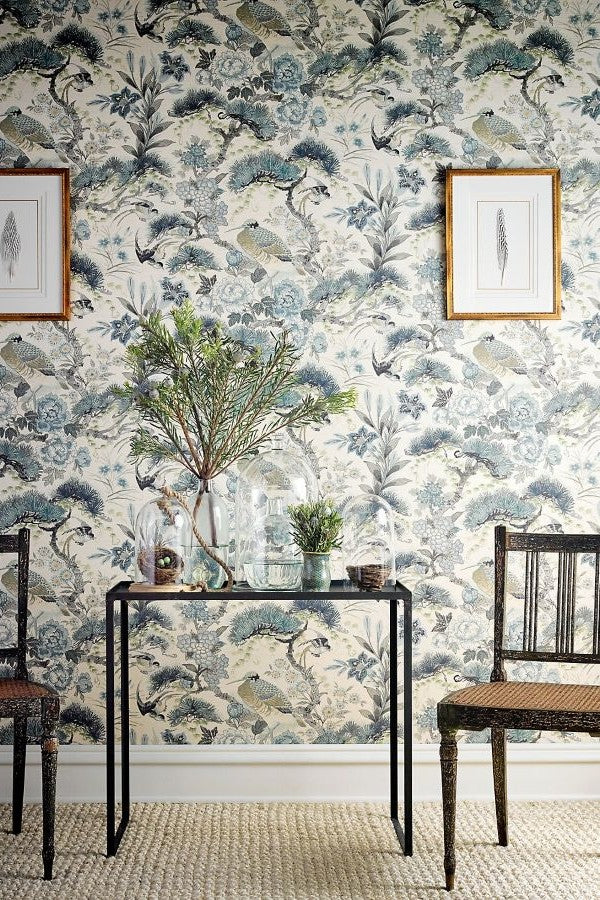
The Power of Two: Two-Tone Designer Fabrics and Wallpapers That Add Instant Contrast

Some of the most sophisticated interiors are built around surprisingly simple color stories. Instead of filling a room with competing shades, designers often rely on the graphic clarity of just two colors—a combination that can make stripes feel sharper, florals more architectural, geometrics more dramatic, and traditional patterns unexpectedly modern.
Two-tone fabrics and wallpapers are especially effective because they deliver pattern without overwhelming a room. Black and ivory can feel tailored and glamorous. Blue and white brings timeless freshness. Chocolate and cream creates warmth and depth. Green paired with natural linen feels relaxed and organic, while red and white can transform a traditional print into a confident focal point.
At The WorkRoom, shoppers can explore luxury designer fabrics, wallpapers and wallcoverings from many of the world's most recognized interior design houses—all online.
Why Two-Tone Patterns Work So Well
The beauty of a two-color pattern lies in its restraint.
When a design is limited to two primary hues, the eye focuses more clearly on scale, line, texture and repetition. A complicated botanical suddenly feels cleaner. A stripe becomes architectural. A small geometric can function almost like a solid from across the room while revealing intricate detail up close.
That versatility makes two-tone designer fabric and wallpaper particularly useful when decorating rooms that already contain artwork, rugs, antiques or statement furniture.
They can also be remarkably easy to coordinate. Rather than matching five or six colors within a multicolored print, a designer can establish one dominant neutral and repeat the accent color throughout pillows, upholstery, draperies or accessories.
Explore the complete designer fabric collection at The WorkRoom for upholstery, drapery and decorative textiles in virtually every style.
Schumacher: Graphic Pattern Meets American Decorating Tradition
Few brands demonstrate the versatility of pattern as effectively as Schumacher fabric.
Schumacher's extensive textile library ranges from archival-inspired motifs and botanicals to stripes, checks, small-scale geometrics and contemporary prints. In restrained colorways, these patterns can take on an entirely different personality.
A black-and-white botanical creates drama without introducing excessive color. Blue-and-ivory patterns feel classic enough for traditional interiors while remaining equally at home in a coastal bedroom or contemporary living space. Neutral geometrics can provide enough movement for an upholstered chair without competing with the rest of the room.
The same approach can be carried onto the walls through Schumacher wallpaper, where graphic repeats, textured designs and decorative motifs can establish an entire room's palette.
Pair a bold two-tone wallcovering with solid upholstery for balance, or reverse the formula by using patterned Schumacher fabric against quieter walls.

Scalamandré: Two-Tone Pattern With Personality
For interiors that call for something memorable, Scalamandré fabric offers an extraordinary range of decorative textiles rooted in nearly a century of American design history.
Scalamandré is particularly effective when a limited color palette is combined with an expressive motif.
Animal patterns, lattice designs, classic stripes and decorative wovens can look surprisingly contemporary when reduced to two strong colors.
One excellent example is Scalamandré's Mandarin Weave, a tightly woven interpretation of classic Chinese fretwork. Its small-scale geometric construction demonstrates exactly why two-tone fabric works so well: the pattern provides dimension and movement while remaining highly versatile for upholstery and tailored window treatments.
The result can be sophisticated rather than busy—proof that a room does not need a complicated palette to make a memorable impression.

Ralph Lauren: Checks, Houndstooth and Heritage Contrast
Few interiors embrace restrained pattern as naturally as the Ralph Lauren Home aesthetic.
The Ralph Lauren fabric collection is filled with the kinds of patterns that thrive in two-color palettes: houndstooth, tartans, checks, plaids and tailored menswear-inspired constructions.
A charcoal-and-cream houndstooth on a club chair can create the atmosphere of an English library. Navy and ivory can move the same concept toward classic American coastal style. Brown and camel combinations feel warm, equestrian and collected.
Because these patterns have such strong historical associations, they also layer exceptionally well with leather, wood, wool, linen and antique furniture.
The same restrained elegance continues through Ralph Lauren wallpaper, where heritage-inspired patterns, stripes and textured wallcoverings create rooms that feel established rather than overly decorated.
Lee Jofa: Refined Pattern for Collected Interiors
For designers who favor sophisticated traditional interiors, Lee Jofa fabric provides another exceptional resource.
Lee Jofa has long been associated with richly layered rooms, but many of its fabrics become remarkably versatile when rendered in restrained color combinations.
A botanical in blue and cream can serve as drapery without dominating the room. A neutral patterned upholstery fabric adds character to a sofa while allowing artwork and antiques to remain prominent. Small-scale patterns can also provide the connecting layer between a larger statement print and nearby solids.
For walls, explore Lee Jofa wallpaper, including designs from Lee Jofa and Lee Jofa Modern.
Two-tone wallpaper is particularly effective in dining rooms, libraries, powder rooms and entryways because the pattern creates immediate visual identity while the limited palette keeps the space controlled.
Kravet: Endless Ways to Work With Contrast
The enormous Kravet fabric collection makes it an especially useful resource when searching for a particular pattern scale or color combination.
Geometrics, stripes, woven textures, classic motifs and contemporary designs can all serve a two-tone decorating scheme.
For a quieter interior, consider cream paired with taupe, charcoal, mineral or soft blue. For stronger contrast, black and ivory can immediately sharpen a room. Even relatively subtle combinations—such as oatmeal and beige—can create visible dimension when woven into a textured fabric.
Kravet wallpaper expands the concept onto walls with geometric, botanical, abstract and decorative patterns from Kravet Design and Kravet Couture.
One of the advantages of working within such a broad fabric and wallpaper library is the ability to coordinate related colors without making every surface match exactly.
That is often where the most interesting interiors begin.

Brunschwig & Fils: Traditional Prints With a Fresh Point of View
Two-color decorating does not have to mean contemporary.
In fact, some of the most compelling examples come from historic textile traditions.
Brunschwig & Fils fabric is known for documentary prints, chintzes, European-inspired patterns and decorative wovens. When these elaborate motifs are rendered in restrained palettes, they become easier to introduce into both traditional and transitional interiors.
Imagine a classic botanical printed only in blue against ivory. The historical character remains, but the reduced palette gives the design clarity.
The same principle works beautifully with toile, damask, small-scale florals and decorative stripes.
This is one reason blue-and-white decorating has endured for centuries: contrast gives traditional ornament structure.
Designers Guild: When Two Colors Don't Mean Playing It Safe
Two-tone decorating is sometimes mistaken for minimalism.
Designers Guild fabric proves otherwise.
Known for expressive pattern, sophisticated color and an artistic approach to textiles, Designers Guild offers countless ways to use contrast boldly without relying on a rainbow of hues.
Deep indigo against white can feel almost painterly. Emerald and cream can turn a botanical into a statement. Charcoal against pale grey creates a more architectural, urban effect.
Because Designers Guild collections are developed to coordinate across fabrics and interior applications, a dramatic pattern can often be balanced with quieter textures and solids from within the same overall design vocabulary.

Phillip Jeffries: Let Texture Become the Second Color
Two-tone design becomes even more interesting when one of the contrasting elements is texture.
The Phillip Jeffries Textiles wallcovering collection demonstrates how woven surfaces, linen-like textures and sophisticated wallcoverings can produce depth without relying solely on printed color.
A subtle stripe can emerge through changes in weave. A light and dark neutral combination can appear dimensional because of the underlying material. Natural fibers can create shadow and variation that make an otherwise simple palette feel extraordinarily rich.
This approach is especially effective in bedrooms, dining rooms, libraries and formal living rooms where the wall surface becomes part of the architecture.
Instead of asking only, "What color should the walls be?" consider asking, "What should the walls feel like?"

Black and White: The Strongest Contrast
There may be no more enduring two-tone combination than black and white.
Black-and-white designer fabric can move easily from a tailored stripe to an animal print, geometric, toile, botanical or abstract motif.
The key is scale.
A large black-and-white pattern can become the focal point of a room. A smaller-scale design can behave almost like texture.
For a sophisticated interior, try using black-and-white fabric on a pair of accent chairs while keeping the sofa neutral. Repeat black elsewhere in a picture frame, lamp or occasional table, and the room immediately feels connected.
Black-and-white wallpaper can achieve the same effect on a larger scale, particularly in an entry, powder room or dining room.
Blue and White: The Forever Combination
Blue and white remains one of the safest investments in interior design precisely because it can become almost anything.
Navy and ivory feels tailored.
Sky blue and white feels relaxed.
Indigo and cream can lean global or artistic.
French blue and ivory can feel traditionally European.
The combination moves naturally between coastal, traditional, transitional, chinoiserie, grandmillennial and contemporary interiors.
It is also one of the easiest palettes to layer. Add natural linen, warm wood, polished nickel, brass, sisal or even a small amount of red or green without losing the simplicity of the underlying scheme.

Brown and Cream: The New Warm Neutral
The return of brown to sophisticated interiors has also renewed interest in chocolate-and-cream, tobacco-and-ivory and camel-and-natural patterns.
These combinations provide contrast without the severity of black.
They work especially well with natural materials: walnut, oak, leather, linen, sisal and grasscloth.
A brown-and-cream geometric upholstered chair can sit comfortably in a modern room, while a chocolate botanical or stripe can easily become part of a traditional library.
The palette is neutral, but never flat.

Green and Natural: Quiet, Organic Contrast
For interiors influenced by gardens, landscape and natural materials, green paired with ivory, parchment or linen offers one of the most livable approaches to two-tone pattern.
Botanicals become an obvious choice, but geometric and striped patterns in green can be just as compelling.
Deep forest green creates drama. Sage produces something quieter and more relaxed. Olive introduces warmth and works beautifully alongside antique wood, brass and brown upholstery.
Because green visually connects interiors with the outdoors, it is particularly effective in sunrooms, breakfast rooms, bedrooms and spaces overlooking gardens.
How to Decorate With Two-Tone Fabric and Wallpaper
One of the easiest ways to use this look is to establish a single patterned hero.
It might be wallpaper.
It might be drapery.
It might be a pair of upholstered chairs.
Once that pattern establishes your two-color palette, allow one of those colors to dominate the rest of the room.
For example, begin with blue-and-white wallpaper. Use mostly ivory upholstery. Repeat blue selectively through pillows or piping. Introduce wood and natural fiber for warmth.
The room feels coordinated because the palette is disciplined, yet it does not feel overly matched.
Another approach is pattern layering.
Combine a large botanical with a smaller stripe or geometric in the same two-color family. Because the colors connect the patterns, the difference in scale creates interest rather than visual confusion.
This technique is especially useful for mixing drapery, upholstery, pillows and wallpaper within one room.
Pattern Doesn't Require More Color
Luxury interiors are often about editing rather than adding.
A beautiful fabric does not need six colors to make an impact. A wallpaper does not need to overwhelm a room to transform it.
Sometimes two colors are enough.
Whether your style leans toward Schumacher's expressive prints, Scalamandré's historic motifs, Ralph Lauren's tailored checks, Lee Jofa's sophisticated decorative textiles, Kravet's enormous pattern library, Brunschwig & Fils' traditional designs, Designers Guild's artistic approach to color or the dimensional wallcoverings of Phillip Jeffries, two-tone patterns offer an easy way to introduce contrast while keeping an interior cohesive.
Explore more than 100,000 luxury designer fabrics at The WorkRoom, or browse our complete collection of designer fabrics, wallpapers and wallcoverings to find the pattern that defines your next room.
The best interiors do not always need more color.
Sometimes they simply need the right two.